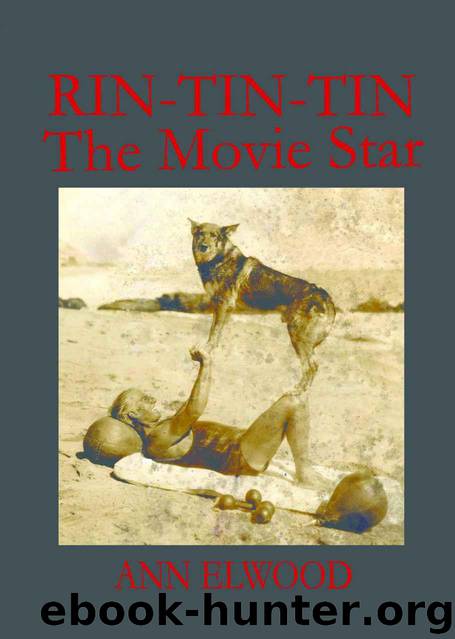
Rin-Tin-Tin:The Movie Star by Elwood Ann
Author:Elwood, Ann [Elwood, Ann]
Language: eng
Format: mobi
Tags: World War I, serials, silent movie, Mascot Pictures, police dog, German shepherd, dog, Ann Elwood, Rin-Tin-Tin, Lee Duncan, movie star, Westerns, war dog, Warner Bros., Hollywood, biography
Published: 2010-12-07T05:00:00+00:00
6
Rin-Tin-Tin, the Magic Actor
In The Night Cry (1926), Rin-Tin-Tin, falsely accused of being a sheep killer (though he does not know that), limps home after a fall from a cliff, opens the door of his family's cabin by releasing the latch with his teeth, slinks in, and shuts the door after himself. The family – father, mother, and baby girl (all humans) – are seated at the dinner table. Expecting the usual love and recognition, Rin-Tin-Tin goes first to the husband (John Harron), who ignores him. He rears up and puts his paws on Harron's body in supplication, but it is as if he – Rin-Tin-Tin – doesn't exist. The wife (June Marlowe), seemingly more conflicted but resolute, also refuses to recognize his presence. With his chin and paws on the table (something like a pathetic Kilroy), Rin-Tin-Tin looks piteously from under his eyebrows to the man and then the woman for acknowledgment, but again he receives no response. The baby (Mary Louise Miller) alone seems to know he is there. She pats his head, giving him some relief from his anxiety. It is heart-wrenching.
Critics have noted the power of this scene. Nearly forty years after the scene was filmed, George N. Fenin and William K. Everson wrote in The Western: from silents to cinerama: “All of the later Rin-Tin-Tin films had at least one situation in which he had to emote, to rely entirely on facial expressions. In The Night Cry in a single take, [he] expresses hope, grief, tolerance, and finally joy, when at least one friend is found in the person of the couple's baby.”
Watching the same scene, a number of my fellow academic friends and I expressed similar reactions, as we let loose with a spontaneous empathetic “Oohhh” at Rin-Tin-Tin's bewilderment and sorrow. However, at a later screening, Jt Clough, a dog trainer, pointed out to me that a plate of food out of camera range could well have elicited the same look of anguish and puzzled sadness from Rin-Tin-Tin. This is, of course, conjecture, but any dog owner will instantly recognize its possibility, once reminded. The eyes of a dog begging at the table look yearningly intelligent and deep. That look of supplication can crack the most resolute of us, if we are not on our guard.
While watching the scene again, alone, in a more analytical mood, I noticed for the first time that Rin-Tin-Tin licks his lips at least twice, which would indicate that a plate of food indeed might have been present. Also he looks toward the camera for direction before appealing to the child, then drops to the floor – it is clear he has heard a command. (Fenin and Everson note, correctly, that in his later films, he did not to seem to be obviously reacting to commands.) Moreover, the only expressions I saw on Rin-Tin-Tin's face in that scene were supplication, hope and joy, not the grief and tolerance Fenin and Everson did.
For further verification of the plate-of-food theory, try setting up a plate-of-food scene with your own dog.
Download
This site does not store any files on its server. We only index and link to content provided by other sites. Please contact the content providers to delete copyright contents if any and email us, we'll remove relevant links or contents immediately.
Cecilia; Or, Memoirs of an Heiress — Volume 2 by Fanny Burney(31934)
Cecilia; Or, Memoirs of an Heiress — Volume 3 by Fanny Burney(31925)
Fanny Burney by Claire Harman(26591)
We're Going to Need More Wine by Gabrielle Union(19030)
Plagued by Fire by Paul Hendrickson(17399)
All the Missing Girls by Megan Miranda(15921)
Cat's cradle by Kurt Vonnegut(15324)
Bombshells: Glamour Girls of a Lifetime by Sullivan Steve(14046)
For the Love of Europe by Rick Steves(13853)
Leonardo da Vinci by Walter Isaacson(13304)
4 3 2 1: A Novel by Paul Auster(12362)
The remains of the day by Kazuo Ishiguro(8965)
Adultolescence by Gabbie Hanna(8909)
Note to Self by Connor Franta(7663)
Diary of a Player by Brad Paisley(7544)
Giovanni's Room by James Baldwin(7315)
What Does This Button Do? by Bruce Dickinson(6194)
Ego Is the Enemy by Ryan Holiday(5409)
Born a Crime by Trevor Noah(5367)
